Loans 

Credit Card
IndiaLends App is available in


Seasonal Business Loan: Planning Funds Around Inventory & Revenue Cycles
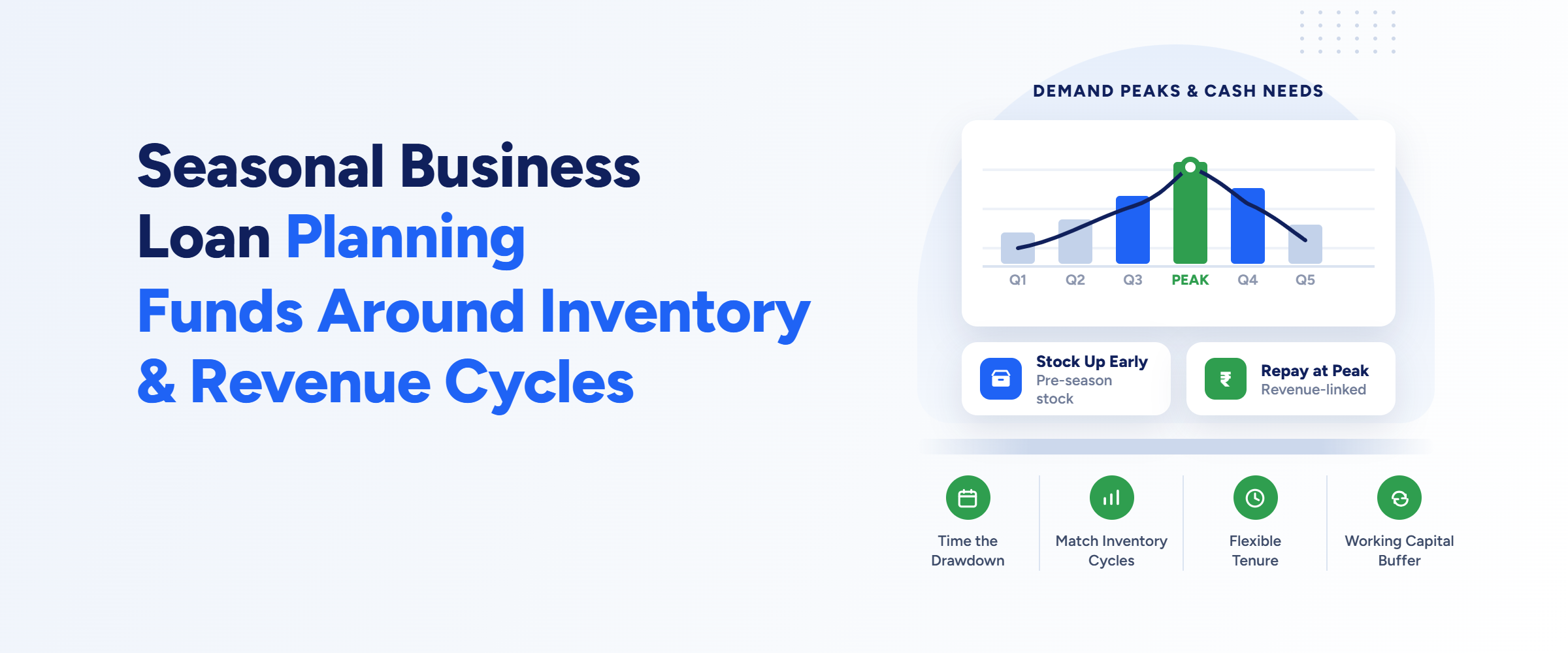
If you run a business tied to festivals, weather, or specific shopping seasons, think Diwali gifting, wedding season textiles, monsoon umbrellas, or summer AC sales, you already know the biggest challenge isn't demand. It's timing your cash flow to be ready before that demand hits.
Buying inventory, hiring temporary staff, and ramping up production all need to happen before the revenue comes in. That gap is exactly where a seasonal business loan becomes one of the most useful tools in your financial planning.
What Makes a Seasonal Business Different
A seasonal business earns most of its annual revenue in a concentrated window, sometimes just 2-4 months a year. Outside that window, cash flow can be thin, but expenses like rent, salaries, and basic operations don't pause.
Common examples in India include:
The core financial challenge for all of these is the same: you need to spend before you earn.
Why Timing Matters More Than Amount
Many seasonal business owners focus only on "how much funding do I need," but the more critical question is "when do I need it, and for how long."
Getting a loan too late means missing the inventory window entirely. Getting it too early means paying interest for months before revenue starts coming in.
1. The Cash Conversion Cycle
This is the time between paying for inventory and actually receiving payment from customers. For seasonal businesses, this cycle is compressed into a short, intense window, making working capital planning critical.
2. Peak vs Off-Peak Funding Needs
| Business Phase | Typical Funding Need |
|---|---|
| Pre-season (2-3 months before peak) | Inventory purchase, bulk stocking |
| Early peak season | Staffing, marketing, logistics scale-up |
| Peak season | Working capital for daily operations |
| Post-season | Loan repayment from accumulated revenue |
3. Short-Term vs Long-Term Financing
Seasonal funding needs are usually best matched with short-term business loans (typically 6–12 months) rather than long-term loans, since the funding requirement itself is temporary and tied to a specific revenue window.
Step 1: Map Your Revenue Calendar
Look at the last 2-3 years of sales data and mark your peak months clearly. This becomes the backbone of your funding plan.
Example – Diwali Gifting Business:
| Month | Business Activity | Cash Flow Pattern |
|---|---|---|
| July–August | Sourcing and inventory planning | Cash outflow begins |
| September | Bulk inventory purchase | Heavy cash outflow |
| October | Peak sales (pre-Diwali) | Strong cash inflow |
| November | Diwali sales continue, clearance | Peak cash inflow |
| December–June | Low activity, planning for next cycle | Minimal cash flow |
Step 2: Calculate Your Inventory Funding Gap
Inventory funding need = Cost of inventory + operational costs during ramp-up − available cash reserves.
Example: Sunita runs a Diwali décor business. She needs ₹8,00,000 for bulk inventory in September, but has only ₹3,00,000 in reserve from last season's profits. Her funding gap is ₹5,00,000, this is the amount a seasonal business loan should cover, not the full inventory cost.
Step 3: Match Loan Tenure to Your Cycle
If your revenue comes in strong by November and tapers by December, a 6-month loan tenure (say, September to February) aligns much better than a 3-year term loan, which would carry unnecessary interest cost through your off-season.
Step 4: Build Repayment Into Your Sales Plan
Structure repayment so that a portion of peak-season revenue is earmarked for loan closure, rather than treating the entire peak inflow as available cash.
Festival Business Loan: A Closer Look
Festival business loan needs typically spike 6-10 weeks before major festivals like Diwali, Eid, or wedding season. Lenders, especially NBFCs, often see a rise in short-term loan applications during this window, and many offer streamlined, faster processing specifically for inventory and working capital needs tied to festival demand.
Key things to keep in mind:
Example: Two Seasonal Businesses, Two Approaches
Business A: Planned Ahead — Rajesh, a wedding season textile wholesaler, applies for a ₹6,00,000 short-term business loan in August, three months before wedding season peaks in November. He gets funds in time, stocks inventory early at better wholesale rates, and repays the loan fully by January using peak-season revenue.
Business B: Reactive Approach — Kavita, running a similar business, waits until October to apply, right as demand is spiking. Processing takes 2–3 weeks, she misses the best wholesale pricing window, and ends up with a smaller loan amount than needed because her application was rushed and less thoroughly documented.
Planning ahead isn't just about approval, it directly affects the terms and value you get from the loan.
Common Mistakes Seasonal Business Owners Make
Expert Tips for Seasonal Business Funding
Get Funded Ahead of Your Next Peak Season
Check your business loan eligibility on IndiaLends and get matched with lenders offering fast, short-term financing built for seasonal inventory and working capital needs.
Check Your Business Loan Eligibility Now
Conclusion
Seasonal businesses don't fail because of a lack of demand, they struggle when funding doesn't arrive in time to meet that demand. Mapping your revenue calendar, calculating your real inventory funding gap, and matching your loan tenure to your business cycle can be the difference between a smooth peak season and a missed opportunity. Plan early, borrow only what your cycle actually needs, and build repayment into your sales strategy from day one.

Scan this QR Code


Latest Articles
Pre-Approved Personal Loan Offers: How to Read the Real Rate
09 Oct 2026
Personal Loan After Credit Card Settlement: Is It Possible?
09 Oct 2026
Account Aggregator Personal Loans: What Lenders Read Beyond Your Salary Slip
08 Oct 2026
Salary Overdraft vs Personal Loan: Which One Should You Use?
08 Oct 2026
Loan Against Mutual Funds vs Personal Loan: Which Is Cheaper?
08 Oct 2026
Relevant Articles
Merchant Cash Advance vs Business Loan: The Real Cost Comparison
30 Sep 2026
Business Loan Turnover Calculation: Why Cash Sales Don't Count
30 Sep 2026
Unsecured Business Loan vs LAP: The Cost and Speed Tradeoff
30 Sep 2026
Udyam Registration and Business Loans: Does MSME Registration Help?
03 Sep 2026
How Bank Statements Influence Business Loan Approval
10 Aug 2026
FAQ’s
A seasonal business loan is short-term financing designed to help businesses fund inventory, staffing, or operational costs ahead of their peak revenue season, typically repaid once that season's revenue comes in.
It depends on your inventory costs and operational scale-up needs during peak season, minus your available cash reserves. Mapping your revenue calendar over the past 2-3 years is the best way to estimate this accurately.
Ideally, 4-6 weeks before your inventory purchase deadline, to allow time for processing and to secure better wholesale pricing before demand and prices rise closer to the festival.
Generally, yes. Since seasonal funding needs are temporary and tied to a specific revenue window, a short-term loan (6-12 months) usually avoids unnecessary interest costs compared to a longer-tenure loan.
Most lenders require recent bank statements (6-12 months), GST returns, business proof, and ITRs. Maintaining these consistently throughout the year makes the approval process faster when you need funds urgently.
 URL copied to clipboard successfully !
Download the IndiaLends App Now
Scan this QR code to download the app