Loans 

Credit Card
IndiaLends App is available in


Can I Take Two Personal Loans at the Same Time? Risks Explained
You already have a personal loan running, and now a new need has come up, maybe a medical expense, a family event, or simply a shortfall you didn't anticipate. The question comes up naturally: can you just take a second personal loan, on top of the one you already have?
Technically, yes, there's no rule against holding multiple personal loans simultaneously in India. But whether you should, and whether a lender will approve it, are entirely different questions. Understanding how lenders actually assess this situation can help you avoid turning a temporary cash need into a much bigger problem.
Is It Legal to Have Two Personal Loans at the Same Time?
Yes, there's no regulatory restriction preventing you from holding multiple personal loans concurrently, whether from the same lender or different ones. The real constraint isn't legal, it's eligibility. Lenders assess every new loan application against your existing debt obligations, and this is where a second loan often becomes difficult to secure, or financially risky even if approved.
1. FOIR Calculation for Personal Loans – The Real Gatekeeper
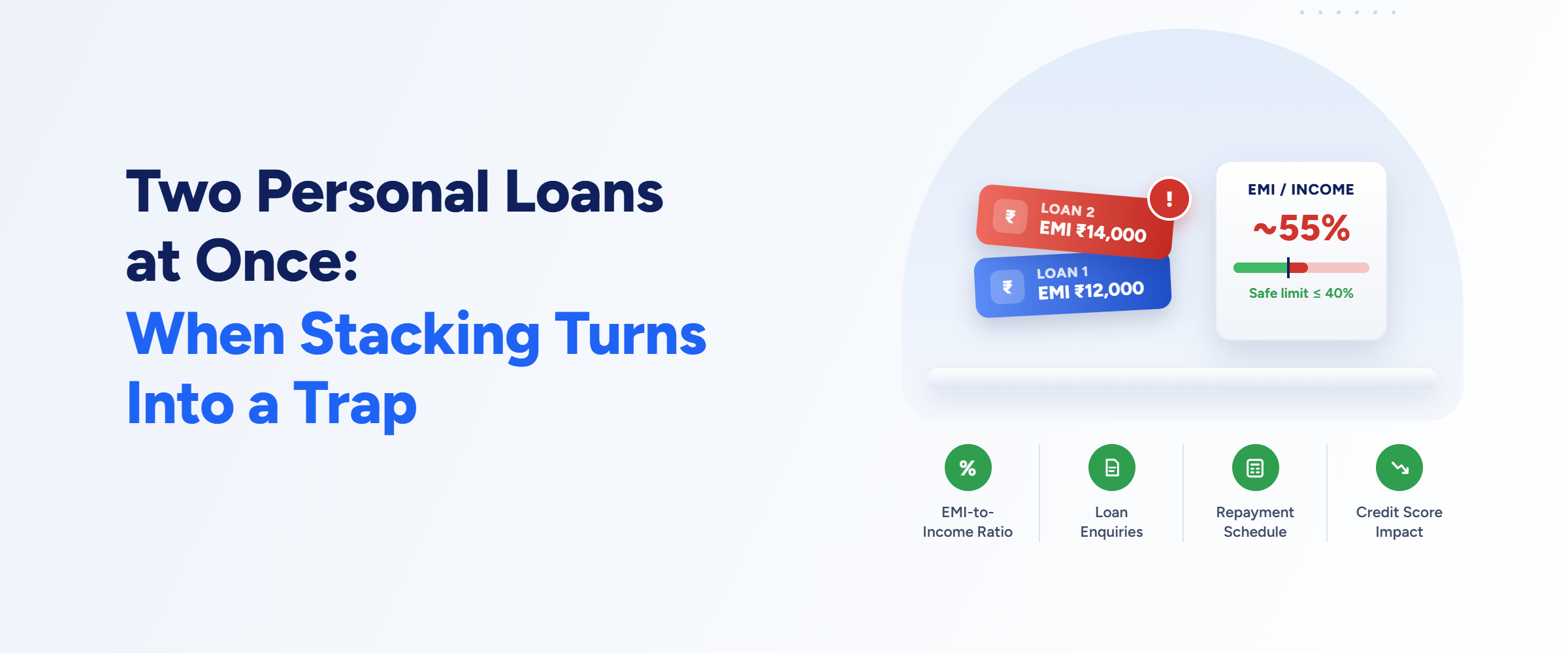
FOIR (Fixed Obligation to Income Ratio) is the single most important number that determines whether you can realistically take on a second personal loan.
FOIR = (Total Fixed Monthly Obligations ÷ Monthly Income) × 100
Fixed monthly obligations typically include:
Most lenders cap acceptable FOIR at 40-50% for personal loan approval, though this varies by lender and by the borrower's overall profile.
Example:
| Amount | |
|---|---|
| Monthly income | ₹80,000 |
| Existing personal loan EMI | ₹18,000 |
| Existing car loan EMI | ₹12,000 |
| Current FOIR | (₹30,000 ÷ ₹80,000) × 100 = 37.5% |
If this borrower applies for a second personal loan with an EMI of ₹15,000, their FOIR would rise to:
| Amount | |
|---|---|
| Total obligations (existing + new) | ₹45,000 |
| New FOIR | (₹45,000 ÷ ₹80,000) × 100 = 56.25% |
This exceeds most lenders' acceptable FOIR threshold, making approval unlikely or possible only at a smaller loan amount that keeps FOIR within range.
2. Multiple Personal Loans and Your CIBIL Score
Holding multiple personal loans doesn't automatically damage your CIBIL score, what matters is how you manage them.
Factors that can hurt your score with multiple loans:
Factors that can actually help, if managed well:
Practical takeaway: the mere existence of two personal loans isn't inherently negative for your CIBIL score, consistent, on-time repayment across both is what protects (and can even strengthen) your credit profile over time.
3. Second Personal Loan Eligibility – What Lenders Actually Check
Beyond FOIR, lenders evaluate several other factors specifically when you already have an active personal loan:
| Factor | What Lenders Look For |
|---|---|
| Repayment history on existing loan | Consistent, on-time EMI payments strengthen your case |
| Overall CIBIL score | Should remain strong despite existing obligations |
| Updated income verification | Recent salary slips/bank statements to confirm capacity |
| Purpose of the new loan | Some lenders may ask, especially for larger amounts |
| Existing lender relationship | Your current lender may offer more flexible terms if you have a clean history with them |
Important: many lenders will simply decline a second loan application outright if your FOIR is already stretched, regardless of how strong your CIBIL score looks in isolation, the ratio itself is often treated as close to a hard cutoff.
4. Overlapping EMI Risk – The Real-World Danger
This is where the conversation shifts from "can I get approved" to "should I do this at all," even if a lender says yes.
Overlapping EMI risk refers to the compounding financial strain of servicing two (or more) personal loan EMIs simultaneously, especially if your income doesn't have meaningful room to absorb both comfortably.
Why this becomes a trap:
| Scenario | Risk Level |
|---|---|
| Two EMIs together well within 40% of income, stable job | Manageable, lower risk |
| Two EMIs together approaching 50%+ of income | High risk, limited buffer for any disruption |
| Considering a loan specifically to pay another loan's EMI | Serious warning sign, reassess the underlying situation |
5. Personal Loan Top-Up vs Second Loan – Which Is Actually Better?
If you already have an active personal loan and need more funds, a top-up loan is often a smarter alternative to a completely separate second loan, worth understanding before you assume a new, independent loan is your only option.
| Factor | Top-Up Loan | Separate Second Loan |
|---|---|---|
| Process | Simpler, since lender already has your data and repayment history | Full fresh application, often with a new lender |
| Interest rate | Often similar to or better than your existing loan's rate, given your established relationship | Depends entirely on the new lender's assessment of your current profile |
| Impact on FOIR | Single consolidated EMI, often more efficiently structured | Two separate EMIs, compounding your FOIR calculation |
| Processing speed | Generally faster, given existing documentation on file | Standard fresh application timeline |
| Eligibility | Based on your repayment track record with the existing loan | Independent assessment, harder if FOIR is already high |
Practical takeaway: if your current lender offers a top-up facility and your repayment history has been clean, this is very often a more efficient and lower-friction way to access additional funds than applying for an entirely separate second loan.
Example: Two Borrowers, Two Approaches
Case 1: Anjali, Responsible Top-Up — Anjali has an existing personal loan with 8 months of consistent on-time payments. She needs an additional ₹1,50,000 for a home repair. Instead of applying to a new lender, she requests a top-up from her existing lender, who, given her clean repayment history, approves it with a single, consolidated EMI that keeps her FOIR comfortably within range.
Case 2: Vivek, Risky Stacking — Vivek has an existing personal loan EMI of ₹22,000 against a ₹70,000 monthly income (FOIR already at ~31%). He takes a second personal loan from a different NBFC for an unrelated need, adding another ₹15,000 EMI, pushing his FOIR to nearly 53%. A few months later, a temporary income disruption makes it difficult to service both EMIs, and he starts missing payments on the second loan, which begins affecting his credit score.
The difference between these two outcomes wasn't the need for additional funds, it was the approach taken to meet it.
Common Mistakes Borrowers Make
Expert Tips for Managing Multiple Loan Needs
Check Your Real Loan Eligibility Before You Apply
Check your personal loan eligibility on IndiaLends and get a clear picture of your FOIR-based eligibility, including top-up options, before taking on additional debt.
Check Your Personal Loan Eligibility Now
Conclusion
Taking two personal loans at the same time isn't illegal or inherently reckless, but it does require an honest look at your FOIR, your existing repayment history, and your genuine buffer for financial disruption. Before assuming a second, separate loan is your only path, check whether a top-up on your existing loan offers a simpler, more efficient route. And if you find yourself considering a new loan just to keep up with an existing one's EMI, treat that as a clear signal to step back and reassess, rather than a routine borrowing decision.
Related reading: Bonus in the Bank: Prepay the Personal Loan or Keep the EMI Running? and Personal Loan Co-Applicant: Benefits, Risks, and Impact on Approval.

Scan this QR Code


Latest Articles
Pre-Approved Personal Loan Offers: How to Read the Real Rate
09 Oct 2026
Personal Loan After Credit Card Settlement: Is It Possible?
09 Oct 2026
Account Aggregator Personal Loans: What Lenders Read Beyond Your Salary Slip
08 Oct 2026
Salary Overdraft vs Personal Loan: Which One Should You Use?
08 Oct 2026
Loan Against Mutual Funds vs Personal Loan: Which Is Cheaper?
08 Oct 2026
Relevant Articles
Pre-Approved Personal Loan Offers: How to Read the Real Rate
09 Oct 2026
Personal Loan After Credit Card Settlement: Is It Possible?
09 Oct 2026
Account Aggregator Personal Loans: What Lenders Read Beyond Your Salary Slip
08 Oct 2026
Salary Overdraft vs Personal Loan: Which One Should You Use?
08 Oct 2026
Loan Against Mutual Funds vs Personal Loan: Which Is Cheaper?
08 Oct 2026
FAQ’s
Yes, there's no legal restriction against holding multiple personal loans simultaneously. However, your eligibility for a second loan depends heavily on your FOIR (Fixed Obligation to Income Ratio) and overall credit profile.
Not automatically. What matters most is how well you manage repayment across all your loans, consistent, on-time payments across multiple loans don't inherently damage your score, but missed payments or an over-leveraged FOIR can.
FOIR (Fixed Obligation to Income Ratio) measures your total fixed monthly obligations as a percentage of your income. Most lenders cap acceptable FOIR at 40–50% for personal loan approval, meaning a second loan can be difficult to get approved if your existing EMIs already consume a large share of your income.
Often, yes. A top-up loan from your existing lender typically involves simpler processing, potentially better rates given your established relationship, and a more efficient single-EMI structure compared to managing two completely separate loans.
The biggest risk is overlapping EMI strain, if your income is disrupted for any reason, servicing two EMIs simultaneously can quickly become unmanageable, potentially leading to missed payments on both loans and significant credit score damage.
 URL copied to clipboard successfully !
Download the IndiaLends App Now
Scan this QR code to download the app