Loans 

Credit Card
IndiaLends App is available in


Personal Loan After Credit Card Settlement: Is It Possible?
You settled a credit card debt some time ago, maybe during a genuinely difficult financial period, and now you're back on your feet, needing a personal loan. But a nagging worry sets in: does a past settlement permanently shut the door on new credit?
The honest answer is nuanced: a settlement makes things harder, but it's rarely a permanent barrier. Understanding exactly how settlements are treated, how long the impact lasts, and what genuinely improves your chances can help you plan realistically rather than assume the worst.
What Happens When You Settle a Credit Card
A credit card settlement happens when you're unable to repay your full outstanding balance, and the lender agrees to accept a reduced amount as full and final settlement of the debt, rather than pursuing you for the complete original amount.
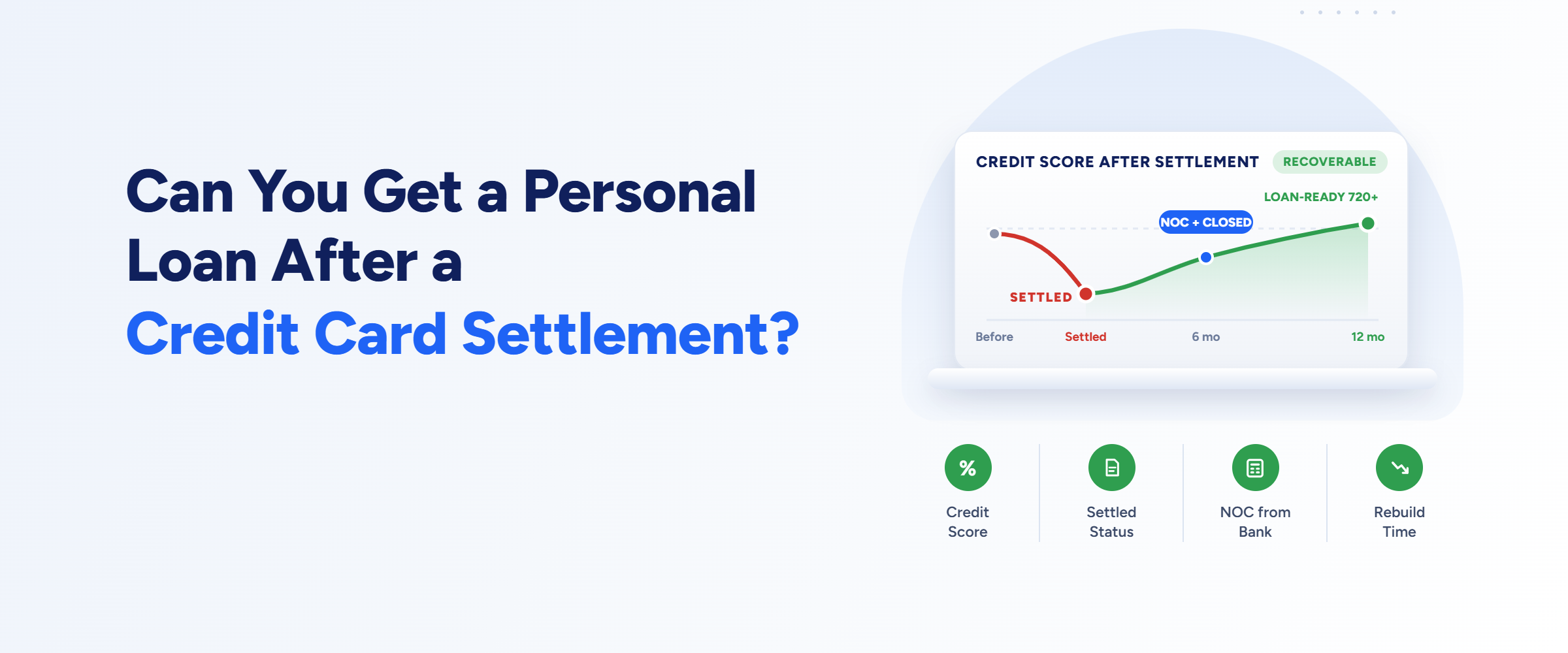
While this resolves the immediate debt, it comes with a specific consequence: your credit report reflects this account not as "Closed" (which signals full repayment) but as "Settled", a status that carries meaningfully different weight with future lenders.
1. Settled Account and Your CIBIL Score – The Real Impact
This is the foundation everything else builds on, so it's worth understanding precisely.
| Status | What It Means | Impact on CIBIL Score |
|---|---|---|
| Closed | Full repayment completed as per original terms | No negative impact; positive credit history |
| Settled | Partial payment accepted by lender as final resolution | Significant negative impact, commonly cited in the range of 75-100 points |
| Written Off | Lender has given up on recovery entirely, often without any payment or agreement from you | Generally considered even more damaging than a settlement |
A "Settled" status doesn't just cause an immediate score drop, it also remains visible on your credit report for up to approximately 7 years, under the standard retention period followed by Indian credit bureaus.
2. Written Off vs Settled – Why the Distinction Matters for a New Loan
It's important not to conflate these two outcomes, since lenders view them differently.
Settled reflects that you actively engaged with the lender and reached a negotiated agreement, even if it meant paying less than the full amount owed.
Written off reflects that the lender unilaterally gave up on recovering the debt, often after an extended period of non-payment and failed recovery attempts, without your active participation in reaching any agreement.
Why this distinction matters: a "Written Off" status is generally viewed even more unfavourably than "Settled" by future lenders, since it signals a more severe breakdown in the credit relationship, the lender essentially concluded that pursuing further recovery wasn't worthwhile. If you're facing financial difficulty and have a choice, actively negotiating a settlement (rather than simply not engaging and eventually facing write-off) is generally the less damaging path, though both carry real consequences.
3. Cooling Period After Settlement in India – Is There a Fixed Number?
This is one of the most commonly searched questions, and the honest answer is: there's no single, universal "cooling period" mandated by RBI or credit bureaus after which a settlement is automatically forgiven or forgotten.
What actually happens is more gradual:
Practical takeaway: rather than counting down to a specific "cooling period" date, focus on actively rebuilding your credit profile, this has a more direct and reliable impact on your eligibility than simply waiting passively.
4. Loan After Compromise Settlement – What Lenders Actually Consider
When a lender reviews your application and sees a past settlement on your credit report, they typically weigh several factors together, not just the settlement in isolation:
| Factor | Why It Matters |
|---|---|
| How long ago the settlement occurred | More recent settlements are viewed more cautiously than older ones |
| Settlement amount relative to your overall credit profile | A small, one-off settlement may be viewed differently than a large one |
| Your credit behaviour since the settlement | Consistent, positive repayment on other accounts since then works strongly in your favour |
| Your current income and repayment capacity | A strong current financial position can help offset historical concerns |
| Overall CIBIL score today | If your score has recovered meaningfully since the settlement, this signals genuine improvement |
| Whether you've settled multiple accounts | A single settlement is viewed differently than a pattern of repeated settlements |
This is why two people with a settled account from a few years ago can have very different outcomes when applying for a new personal loan, the settlement itself is just one data point in a much broader picture.
5. NBFC Loan After Settlement – Are NBFCs More Flexible?
In practice, NBFCs are often more willing to consider applicants with a past settlement than some traditional banks, particularly larger public sector banks with more conservative, rules-based underwriting.
Why this pattern exists:
This doesn't mean approval is guaranteed, but it does mean that if a bank declines your application due to a past settlement, exploring NBFC options (while being prepared for potentially higher interest rates) is a reasonable next step rather than assuming all credit is unavailable to you.
How to Improve Your Chances After a Settlement
Example: Two Borrowers, Different Timelines
Case 1: Ajay, 4 Years Post-Settlement — Ajay settled a credit card debt of ₹80,000 four years ago during a job loss. Since then, he's held a secured credit card, made all payments on time, and his CIBIL score has recovered to a respectable range. When he applies for a personal loan, an NBFC reviews his full profile, noting the old settlement but weighing it against four years of clean, positive credit behaviour since, and approves his application, albeit at a slightly higher interest rate than someone with a spotless history.
Case 2: Priya, 6 Months Post-Settlement — Priya settled a credit card debt just 6 months ago. When she applies for a personal loan shortly after, most lenders view the settlement as too recent, with insufficient time having passed to demonstrate a genuine pattern of financial recovery. Her application is declined by several banks, though one NBFC offers a smaller loan amount at a higher rate, treating her as a higher-risk applicant given the recency of the settlement.
The core difference between these outcomes isn't the settlement itself, both had one, but the time elapsed and credit behaviour demonstrated since.
Common Mistakes Borrowers Make
Expert Tips for Rebuilding Eligibility After a Settlement
Check Your Personal Loan Eligibility Today
Check your personal loan eligibility on IndiaLends and get a realistic view of your options across multiple banks and NBFCs, whatever your credit history looks like.
Check Your Personal Loan Eligibility Now
Conclusion
A credit card settlement makes getting a new personal loan harder, but it's rarely a permanent barrier, what matters most is time elapsed, the credit behaviour you've demonstrated since, and how proactively you've worked to correct and rebuild your profile. If you can clear any remaining dues and get your status updated to "Closed," do so. Beyond that, patient, consistent, positive credit behaviour is the most reliable path back to full loan eligibility, and exploring NBFC options alongside traditional banks can widen your realistic possibilities in the meantime.
Related reading: Should You Take a Personal Loan During Your Notice Period?, Two Personal Loans at Once: When Stacking Turns Into a Trap, What Lenders Now Read in Your Account Aggregator Data, and Bank vs NBFC Loan: How to Choose the Right Offer.

Scan this QR Code


Latest Articles
Pre-Approved Personal Loan Offers: How to Read the Real Rate
09 Oct 2026
Account Aggregator Personal Loans: What Lenders Read Beyond Your Salary Slip
08 Oct 2026
Salary Overdraft vs Personal Loan: Which One Should You Use?
08 Oct 2026
Loan Against Mutual Funds vs Personal Loan: Which Is Cheaper?
08 Oct 2026
Can I Take Two Personal Loans at the Same Time? Risks Explained
08 Oct 2026
Relevant Articles
Pre-Approved Personal Loan Offers: How to Read the Real Rate
09 Oct 2026
Account Aggregator Personal Loans: What Lenders Read Beyond Your Salary Slip
08 Oct 2026
Salary Overdraft vs Personal Loan: Which One Should You Use?
08 Oct 2026
Loan Against Mutual Funds vs Personal Loan: Which Is Cheaper?
08 Oct 2026
Can I Take Two Personal Loans at the Same Time? Risks Explained
08 Oct 2026
FAQ’s
Yes, it's possible, though it depends on how long ago the settlement occurred, your credit behaviour since then, and your current financial profile. It's generally more difficult immediately after a settlement and becomes more feasible as you rebuild positive credit history over time.
A "Settled" status typically remains visible on your credit report for up to approximately 7 years, following the standard retention period used by Indian credit bureaus.
No single, universal cooling period is mandated. Instead, lenders assess your full credit profile at the time of application, including how long ago the settlement occurred and your behaviour since, rather than applying a fixed waiting period.
Generally, yes. A written-off status indicates the lender gave up on recovery entirely, often without your active participation, and is typically viewed even more unfavourably by future lenders than a settled account.
Often, yes. NBFCs frequently use more flexible, sometimes cash flow-based underwriting and may be more willing to consider applicants with a past settlement, though typically at a higher interest rate reflecting the additional perceived risk.
 URL copied to clipboard successfully !
Download the IndiaLends App Now
Scan this QR code to download the app